ONOZU — AUSTRALIA
Wind Before Sunrise
Before daylight reaches the coast, a steady wind moves through dune grass and redraws the dark surface of the sea.
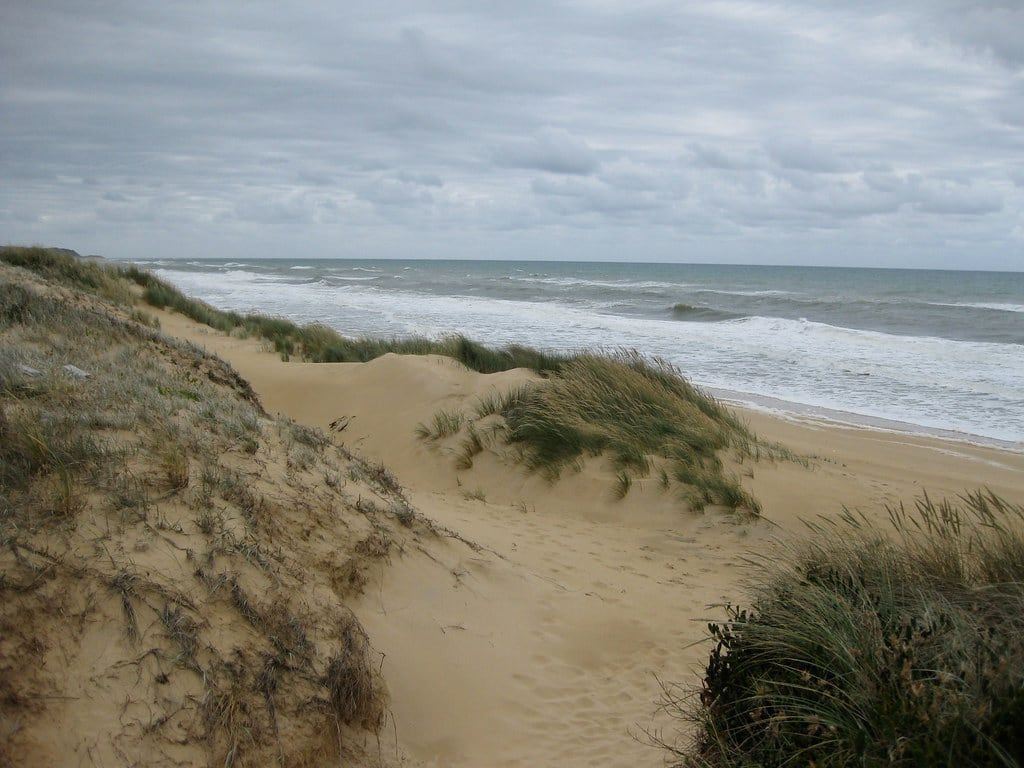
Dunes by Phillie Casablanca. Source, licensed under CC BY 2.0. Auto-oriented, resized, metadata stripped, and recompressed; responsive AVIF/WebP derivatives are generated at build time.
Before sunrise, the wind is easier to notice than the landscape. It arrives across the dark water, presses the dune grass in one direction, and moves loose sand along the firmer edge of the path. The sea can be heard beyond the low ridge before its surface is visible. Each wave has a separate beginning, then dissolves into a continuous rush along the shore.
The sky lightens from the horizon upward. At first, sea and cloud occupy nearly the same range of grey. A thin opening in the east gains a cooler blue, while the land remains without detail. Fence posts and shrubs stand as dark forms, their shadows not yet present.
The shape of moving air
Wind gives the plants a shared direction, but their responses differ. Long grass bends close to the ground and rises again between gusts. Tougher leaves turn at their stems, briefly showing a paler underside. Low shrubs barely move at the centre, although their outer branches tremble continuously.
The path records movement in quieter ways. Fine grains gather behind stones and along old footprints. Small ridges appear where the surface is dry enough to shift. Closer to the water, damp sand holds its shape and reflects the growing sky. A line of foam advances across it, pauses at its furthest point, and leaves a darker boundary as it retreats.
Birds travelling along the shore adjust their height in the gusts. Some fly close to the water, using the air rising from a wave; others settle behind the dune where the wind is weaker. Their calls are carried inland, sometimes clear and sometimes lost beneath the next breaking wave.
First direct light
When the sun reaches the horizon, colour appears on selected surfaces rather than everywhere at once. The upper edges of clouds warm first. Wet sand takes on a narrow band of light, and seed heads above the dune become distinct against the darker land.
The wind continues after sunrise, but daylight makes its effects familiar. What had been sound and pressure becomes visible movement across water, grass, and sand. The early coast shows that wind is not empty space passing through a scene. It is one of the forces arranging the scene from moment to moment.